Cooking with Air Horn
What would you do if a bear came to your kitchen window? Keep your cool, then clearly call for HALP! That was the scene for guests in late May when both one family and then another couple cooked some nice steaks (indoors). While the second batch was still sizzling, Mr. Bear came a-calling, peering in the window of the Retreat Cabin kitchenette.

Guest orientation always emphasizes being ‘bear aware’ about cooking and handling trash, so there haven’t been in-Camp sightings for quite a while. But the smell of those juicy T-bones was more than enough to bring in Big Teddy for a visit mid-May.
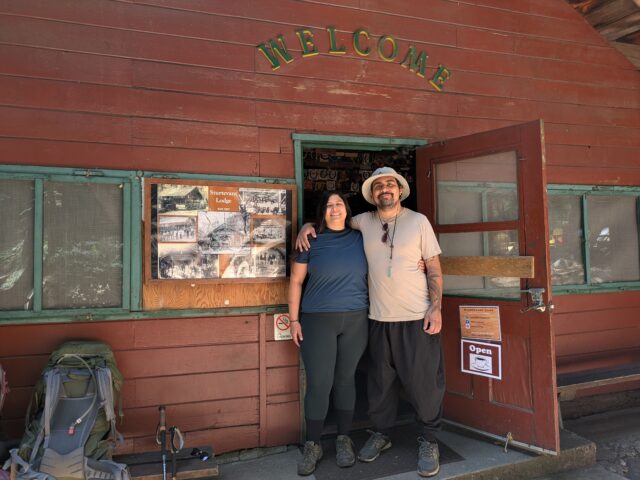
Like most before him (and this was a male, not a mom with cubs), he was VERY disappointed when the air horns and yelling started up to drive him away. Like a scolded dog, he slowly moved up the hill, but was reluctant to give up: he tried hiding behind a tree, but his rump stuck out one side while he peered around the other!
Teddy eventually moved on, and one of the guests—who happened to be a State game warden!—confirmed the hazing was textbook. Bears are mostly like hungry dogs, and don’t want confrontation. Making noise, looking big, standing still (not turning/running) usually does the job.
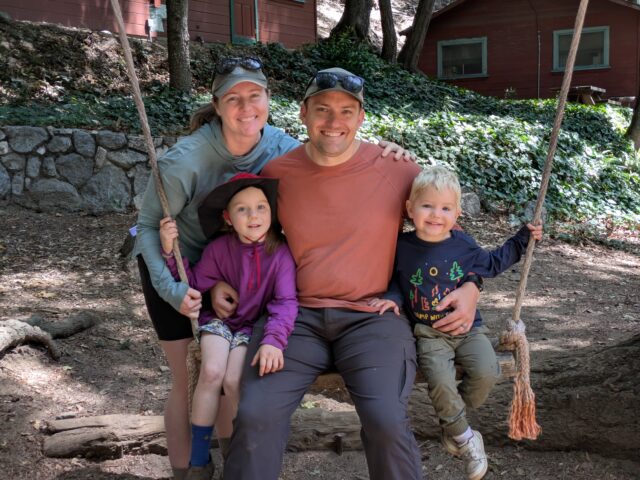
Next time though, maybe some nice pasta?!
Movie Review: Toy Story 5
By Gary Keene
If you laugh and cry a bit less at this fifth installment in the Toy Story film franchise, it’s only because you already know most everyone, and can see where the plot has to go. The now traditional Toy Story theme of loss and letting go, expressed through kids growing up relative to the stars of the show—the toys Woody, Jesse, Buzz and the gang—is all here, but with a new and added element: a serious warning about the effects of technology on kids.

For parents or kid-adjacent folks, this is a front-burner issue aflame in the news; the negative effects are well documented, individual and class-action lawsuits are flying against social media companies, and every parent is struggling with if/when their kids “should” have a phone.
What TS-5 does is give this cultural dilemma emotional weight and creative casting. The abstractions of the issue are stripped away, and parental fumbling is made obvious and nearly tragic: Bonnie (the child at the center of the story) is having a hard time making friends, so Mom and Dad try to get her connected with her digitally-powered peer group by giving her an internet-enabled tablet. Which of course quickly leads to exactly the opposite: the device becomes a tool for ostracizing and shaming Bonnie, further isolating her.

The writers make a handy plot twist in the third act by having the tablet develop empathy (a scary inference of AI becoming sentient and self-conscious!) so that Bonnie finds another odd-ball kid to connect with. This being Pixar/Disney, of course all ends well, for now, but the warning message is clear: children need time to develop human sensibilities and humane skills directly with other humans. It’s a shout out to get kids off-screen from “ultra-processed time” (see below) and instead grounded in the really real before they’re whooshed into the harsher realities of young adulthood and beyond. Bottom line, this is a movie about kids that parents can take their kids to see for entertainment; but for parents and the rest of us, it’s a message movie to be taken seriously. With that in mind—
Touch Grass- Insult or Invite?
Merriam-Webster defines the phrase ‘touch grass’ as “To participate in normal activities in the real world especially as opposed to online experiences and interactions.” It goes on to quote Catriona Morton, “To be told to touch grass is intended as an insult for people who spend too much time online, disconnected from the reality outside their pixelated screens.”
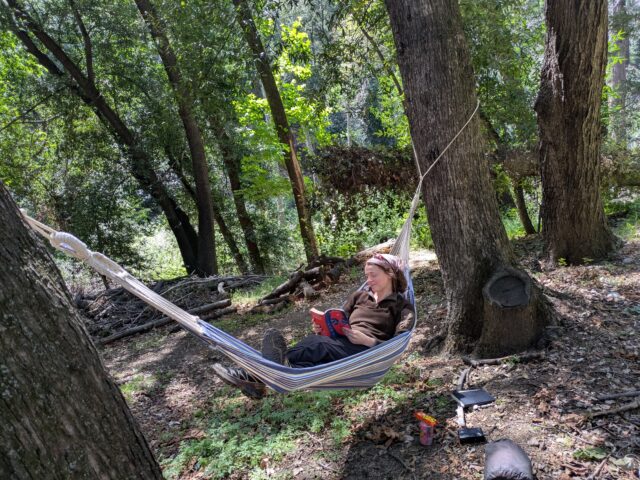
But proof of how quickly a catchphrase can evolve, the New York Times just issued its ‘Summer Touch Grass Challenge’. It’s pretty simple; a weekly posting of ways to get outdoors and ‘touch grass’. Why? Times author Jancee Dunn writes,
“More than half of U.S. adults say they are on their devices too much. We also spend around 90% of our time inside. Dr. John La Puma, an internist and author of “Indoor Epidemic,” calls these moments we’re on our phones “ultra-processed time,” because they don’t replenish us. Much like ultra processed food… ultra-processed time is “engineered for convenience, compulsion and stimulation, not for nourishment.”Here at Sturtevant, we propose touching grass—and white sage, manzanita, dirt, running water over granite, and Bigcone Spruce trees. Call it “trail-processed time.” There’s plenty of it on the way to Camp. Come on up for different kind of re-boot (yes, pun intended.)
Normal is Cool – Literally

Spring has merged into summer marked by the annual scourge of deer-flies balanced by the blooming of abundant Humboldt Lilies; while temps have risen, it’s still cooler in Camp than down below by 10-15 degrees. Otherwise it’s business as usual: the pack train delivering and picking up, guests arriving and relaxing, work and repair projects progressing, and some very frisky deer hanging around Camp. Come on up and try it sometime.
Why We Have (More) Adirondack Chairs
When Wilbur set out to build the Lodge in 1892, he was surely influenced by the “Great Camps” of the Adirondack mountains in New York State. Starting in the 1870s, city aristocrats built get-aways in the woods modeled in part on Swiss chalets (Sturtevant often advertised the Lodge as the “Swiss Dining Pavillion”).
The Adirondack ethos and style focused on buildings and furniture using local, natural materials and showing the craft of handwork, in part a response to the flourishing second Industrial Revolution. The look also mimicked yet subverted the Victorian-era style of fancy woodwork by weaving branches into delicate designs, easily seen in old photos of the Lodge and Ranger Cabin.
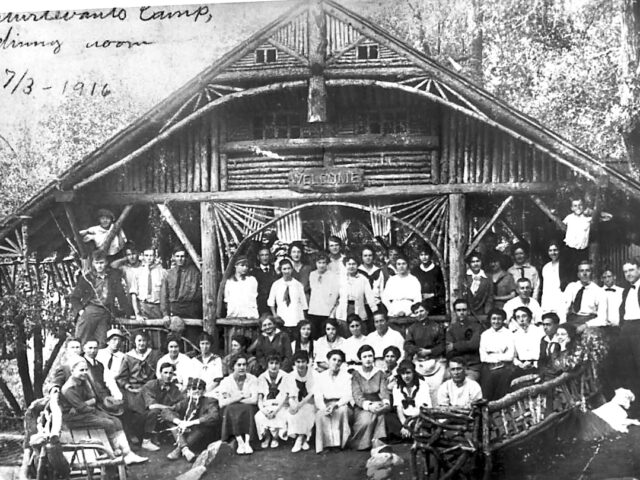
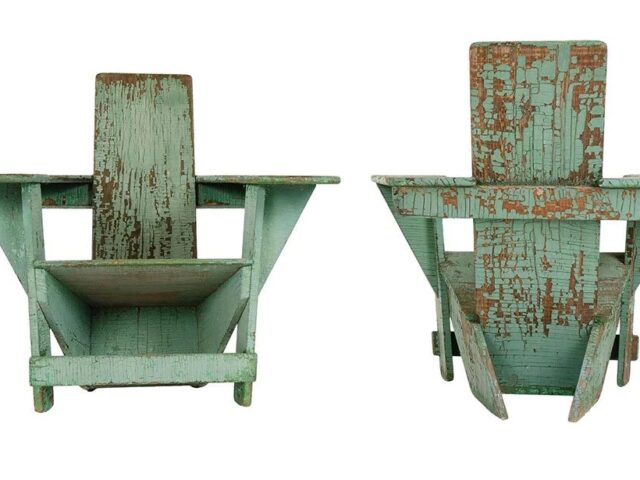
And, one of the most distinctive and enduring expressions of the Adirondack style is the infamous Adirondack chair, found on many patios everywhere. Sarah Maggori writes,
“In 1903…on the western shore of Lake Champlain, …Thomas Lee was looking for a chair that would sit comfortably on the steep slope of his summer property. He sketched 11 prototypes …before arriving at the wide, flat-armed, slanted-back form we now recognize. Lee gave the design to a carpenter friend, Harry Bunnell, who patented it in 1905 as the Westport Plank Chair.” (Architecture and Living Magazine, April 22, 2026.)
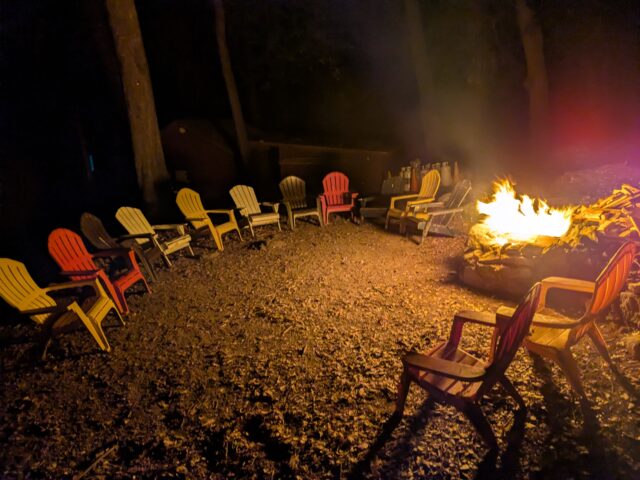
For quite a while now, the Camp has had a ramshackle collection of Adirondack chairs in plastic and wood circled near the center of Camp. Hikers and guests appreciate the chance to sit down and rest—and look up and around to admire the Camp’s beautiful setting. But the combination of weary hikers dropping their full weight into the chairs combined with the constant assault of weather has sent one chair after the other onto the slash-pile.
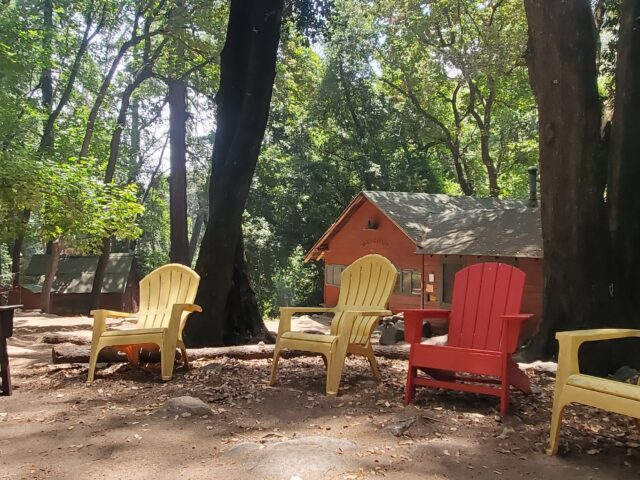
Precisely because the chairs are such a welcoming (and colorful) amenity, the Board is investing in new replacement chairs; they’re again in the Adirondack style, but built with a sturdier design and materials that hopefully will better withstand the abusive environment.
They’re not cheap, and they’re not lightweight, meaning the cost to pack them is also not cheap. So if you have enjoyed or expect to enjoy a nice sit-down in Camp, consider a donation to support the investment in durable, delightful seating!
Paul’s Book Recommendation
“Los Angeles, 1930s – The young woman looked like an angel as she gazed absently at the heavens through the telescope atop Mt. Wilson. But it was doubtful she saw anything. She appeared to have been dead for hours.”
That’s the Amazon intro to “Foreign Bodies: A Detective Mathieu Mystery” by Micahel L. Nichols. The noir tale is set in/around LA, including the Mt. Zion trail and Big Santa Anita Canyon—according to Sturtevant’s own Site-Ops Manager Dr. Paul Witman. If you’re into detective stories and want to check the author’s references against your own trail experience, check out this book!
Happy Trails! The Sturtevant Conservancy